
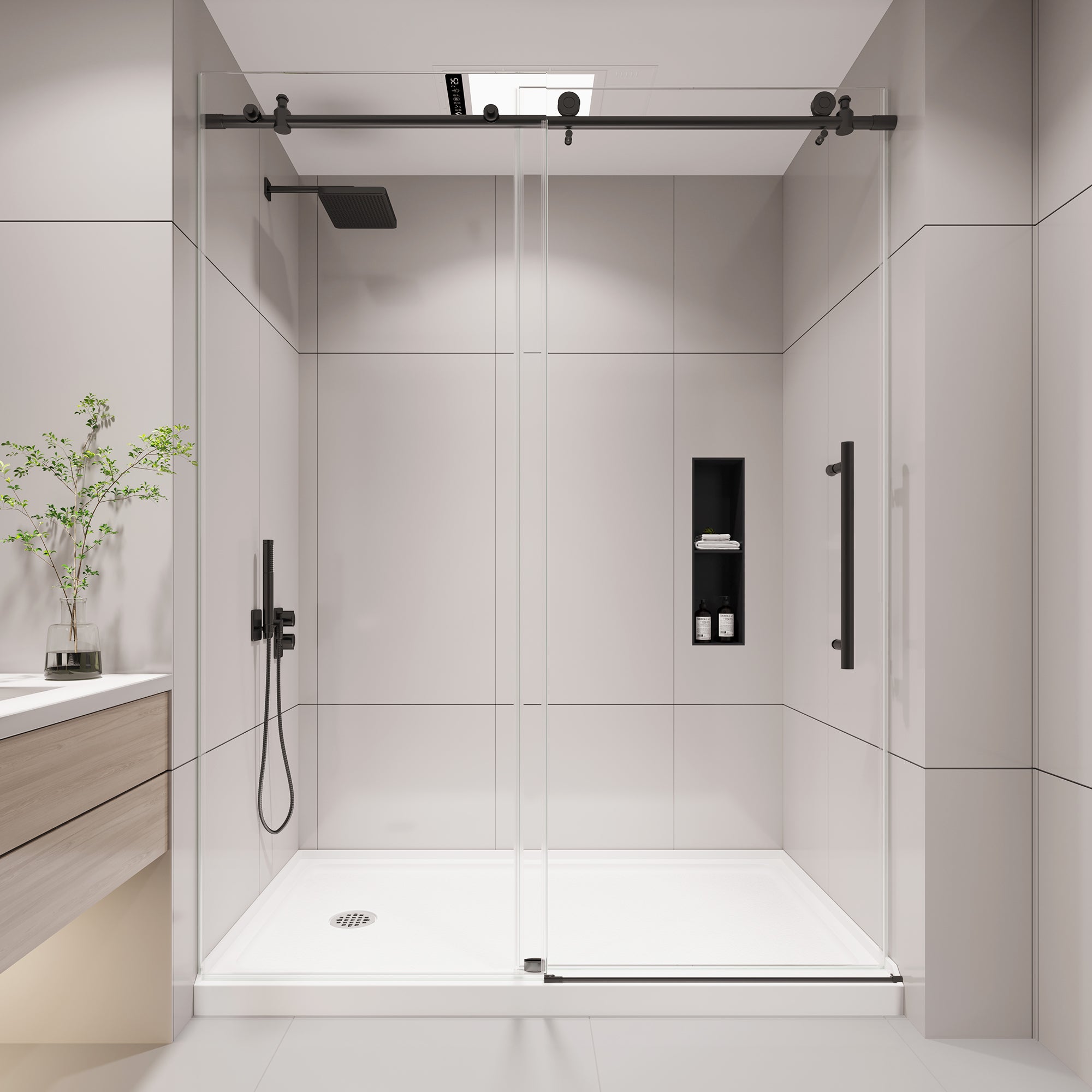
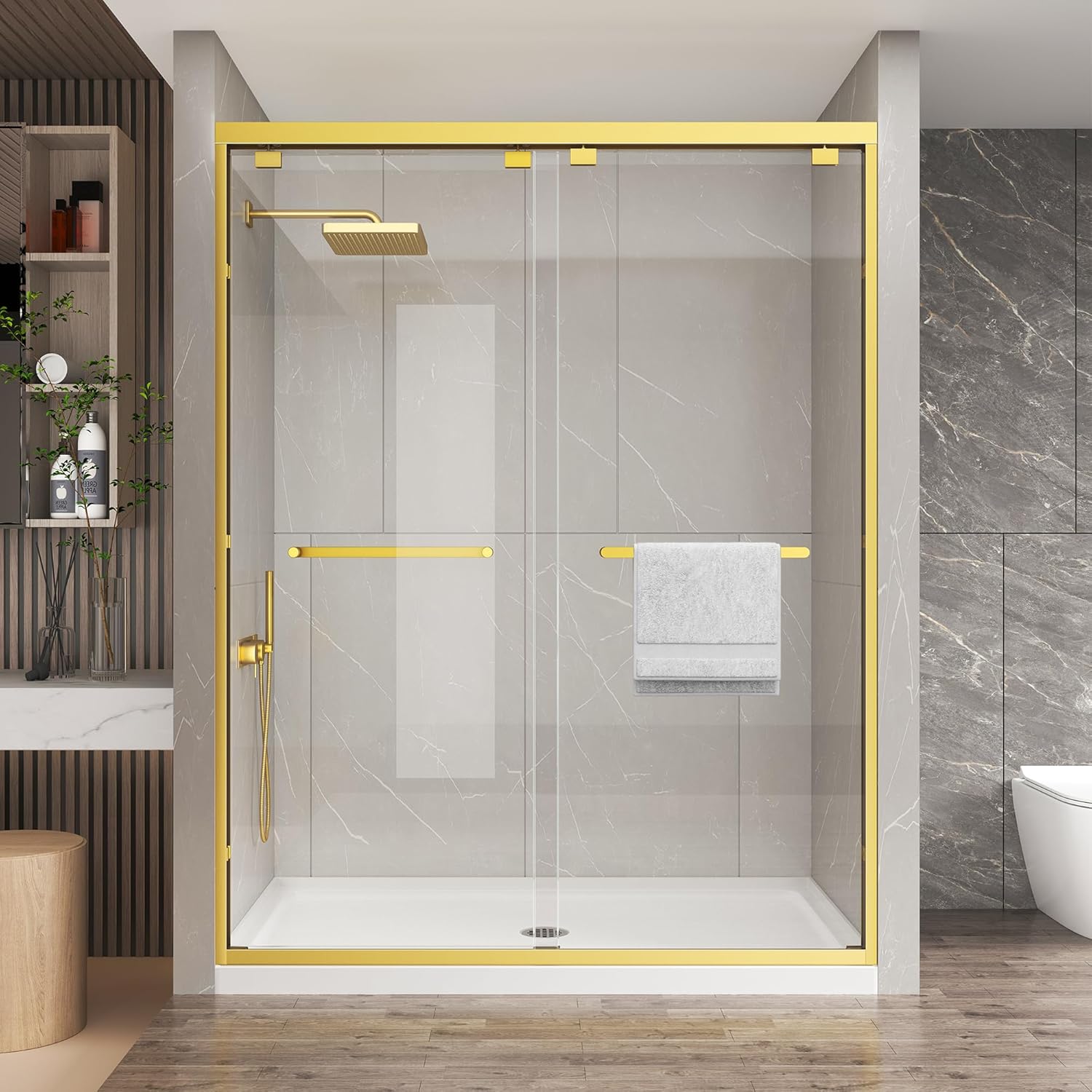
A shower door for a shower base should be chosen by the opening, curb geometry, and door clearance—not the base’s advertised size alone.
A base’s nominal width is not necessarily the finished opening width, and a door’s listed width range does not prove it will suit the curb or walls. Measure the installed shower, then compare those measurements and conditions with the specific door’s requirements.
Choose in this order
- Measure the finished opening. Measure wall to wall where the door will mount—at the bottom, middle, and top. If the measurements differ, the walls may be out of plumb; a door’s adjustment range must accommodate the actual opening. Don’t use the base’s box size as a substitute.
- Look at the curb or threshold. A sliding door generally needs a continuous, sufficiently wide landing for its track. A pivot door needs a suitable mounting area for its hinges. The curb should be sound and direct water toward the shower; a shape or slope that conflicts with the door system can rule it out. The specific door’s requirements determine what curb profile works.
- Choose how the door should open. A pivot door swings into the bathroom, so rule it out if the door would hit a toilet, vanity, or other obstruction. A sliding door avoids that swing arc, but its panels and overlap affect the usable entry. Consider who needs to enter and how much clear access they need.
- Measure the available height. Measure from the top of the curb to the intended top of the enclosure, and account for anything above or beside the opening. The door must fit the available height; the base’s width does not answer this question.
- Check the mounting surfaces. Note whether the walls are tiled, uneven, or otherwise difficult to anchor into. A suitable opening measurement alone does not show that the wall can support the door’s mounting hardware. If the anchoring location or wall support is uncertain, resolve that before ordering.
- Compare the exact door’s range and installation limits. Confirm that your measured opening falls within its stated width range, then find the required curb landing, wall adjustment allowance, and mounting conditions. These details decide whether a nominally similar door can actually be installed on your shower.

Pivot Shower Door — Matte Black
View Product
Frameless Sliding Glass Shower Door
View ProductA dimension example is not a fit recommendation: listed width bands describe a door’s intended opening range, not proof that its track, hinges, or wall profile match your base. For example, KPUY lists a frameless pivot door in width bands from 24–26 inches through 36–38 inches at 72 inches high, while its sliding-door listings include different width and height ranges. Compare the exact option with your measurements and curb conditions; the numbers alone cannot establish fit.

What rules an option out?
- Opening outside the listed range: Don’t assume a door can be cut down or adjusted beyond its stated limits.
- Not enough clearance for a swing: A pivot configuration is unsuitable if the door’s path is blocked.
- No suitable track landing: A sliding system may not work if the curb can’t accommodate its required track placement.
- Unresolved wall or curb conditions: Uneven walls, an incompatible curb profile, or uncertain anchoring can prevent proper installation even when the width appears right.
The main unknowns are the requirements of the exact door model: its curb dimensions, permitted wall variation, mounting support, and sealing details. Those determine whether the measured shower is compatible, not the product title or a broad size label. To compare available styles and size ranges, explore KPUY’s shower doors.
When to pause before ordering
Don’t proceed if the base or curb is cracked, loose, or visibly unstable, or if the wall surface cannot safely support the door. Resolve the underlying condition first; a new door does not correct a damaged base or weak mounting area.
Related questions
Can a shower door sit directly on a one-piece surround?
It depends on the surround’s shape and the door’s mounting requirements. Check whether the door is designed for that wall and threshold profile, including any molded ridges or uneven surfaces where a track or seal would sit. A flat-looking area is not, by itself, proof of compatibility.
Is a sliding door always better for a small bathroom?
Not always. Sliding doors avoid a swing arc, which can help when space outside the shower is tight, but the panels affect the usable entry. Compare the clear opening with the access you need; a pivot door may be practical if its swing path is unobstructed.
Can I keep a shower curtain if the curb doesn’t suit a glass door?
A curtain may be a practical choice when a glass-door track or hinge cannot work with the curb, or when a swing would be blocked. It still needs to hang inside the shower enough to direct water toward the base, so consider how the curtain will sit during use.
Conclusion
Measure the finished opening at several heights, assess the curb and wall mounting areas, and choose a door style that fits the room’s clearance needs. Only then compare the exact door’s size range and installation requirements; a matching advertised width is not enough to establish fit.

Leave a comment
All comments are moderated before being published.
This site is protected by hCaptcha and the hCaptcha Privacy Policy and Terms of Service apply.