
Low natural light in a bathroom forces trade-offs: you want a shower door that keeps the room feeling open, meets safety and code, and installs cleanly on imperfect walls. I’ve been installing and specifying shower doors in American homes for 20+ years. In tight, dim bathrooms the right door choice—from glass thickness and finish to door style and hardware—makes the space feel larger while staying within installation tolerances and building codes like ANSI Z97.1 and local plumbing provisions. Below I walk through practical options, on-site realities, and step-by-step decisions you can use right now.
Quick answer (featured-snippet style)
Pick a clear or low-iron tempered glass door (3/8" or 1/2"), minimal framing, and polished chrome or bright nickel hardware to maximize light. Use a sliding or inline door where swing is limited, add layered artificial lighting, and allow installation tolerances for out-of-plumb walls and curb slope. For safety and code compliance, specify tempered glass that meets ANSI Z97.1 and confirm local plumbing/ventilation requirements.

Why natural light matters (and what the door can do)
Natural light affects perceived space, color rendering, and the effectiveness of task lighting around a vanity. In bathrooms with small or no windows, the shower door’s optical properties play a huge role. A wrong glass choice—like heavy frosting or patterned glass—will reduce light transfer and make the room feel smaller. Conversely, clear or low-iron glass can let the limited daylight travel through the shower enclosure and brighten the whole bath.
- Clear vs low-iron glass: Low-iron gives truer whites and slightly higher visible light transmission than standard clear glass.
- Frosted or patterned glass: Useful for privacy but reduces brightness—use sparingly in small, dark bathrooms.
- Frame and hardware: Dark, bulky frames break up sight lines. Slim profiles reflect less light and look cleaner.
Key decisions: glass type, frame, and door style
Make choices in this order: glass clarity/thickness → door operation (swing vs sliding) → frame/profile → hardware finish. That sequence prioritizes light performance, function, and long-term durability.
Glass choices
- Clear tempered glass (3/8" or 1/2") — Best balance of light transmission and stiffness; less distortion; common on frameless doors.
- Low-iron tempered glass — Slightly more expensive, but the best option if every bit of light counts and you want true color rendering.
- Frosted or acid-etched glass — Use only when privacy is a must; consider a clear strip at eye level to let light through.
Frame and profile
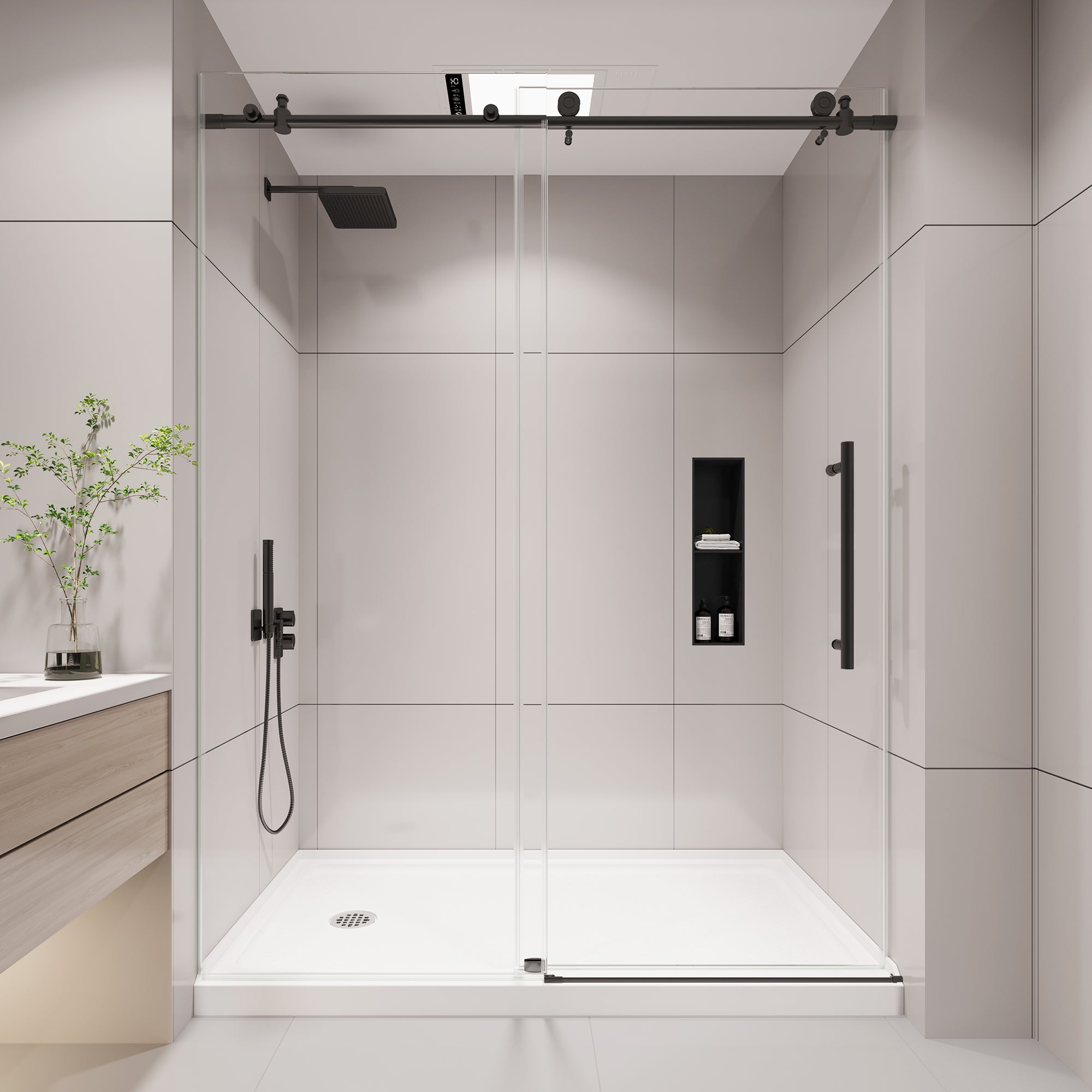
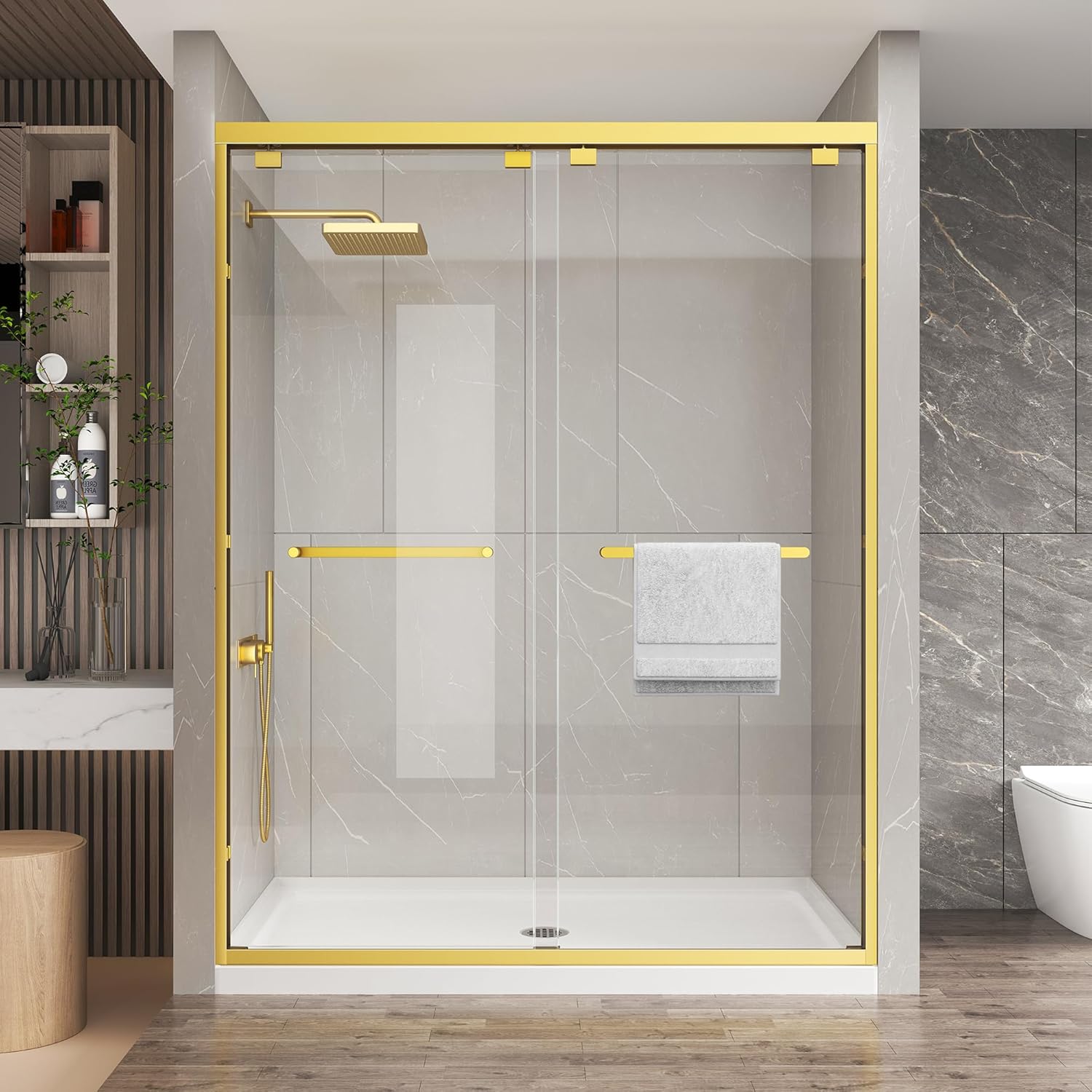
Frameless or semi-frameless systems maximize light and look modern. Fully framed doors with dark frames can absorb light and make a small bathroom feel cramped. If your walls are out-of-plumb, semi-frameless systems with adjustable channel seals are more forgiving during installation.
Door operation
In tight bathrooms choose sliding (bypass) doors for space-saving, or an in-line sliding with a stationary panel to keep sight lines open. Pivot doors look great but require clear swing space; if you have a short distance between toilet and shower, pivot can be a problem. For showers with a small curb, keep the threshold low but ensure curb slope and drain location prevent standing water.
Lighting and layout strategies to compensate for low natural light
Artificial lighting is your partner. A good lighting plan makes a clear glass door perform even better.
- Layer lighting: Combine ceiling downlights, a vanity-focused task light, and an LED strip or recessed light over the shower. Use CRI 90+ fixtures for accurate color.
- Positioning: Place a light above or inside the shower to eliminate shadowing. Recessed fixtures with proper wet-location rating are common.
- Reflective surfaces: Lighter tile, a gloss finish, and bright grout all help bounce light. Avoid overly dark tiles next to a clear glass panel.
Best practice: spec shower lighting that’s on a separate switch or tied to the vanity so homeowners can create zones depending on task.

Jobsite realities and real-world tips from 20+ years on the floor
I work on a lot of older homes where walls are off by 1/4" to 3/4" over a 6-foot height. That may force thicker glass or framed systems. Here are direct, practical tips I use every week:
- Allow glass size tolerance: Order glass with field-measure allowances when walls are out-of-plumb. A common strategy is to have a 1/4" to 3/8" shim clearance per side and confirm site measurements before final fabrication.
- Expect uneven curbs: Check curb slope and height. A 1/4" high spot at the threshold can prevent a door from closing properly—address with leveling or an adjustable hinge.
- Tempered glass thickness: Use at least 3/8" tempered for small frameless panels; 1/2" for larger panels or where glass spans exceed typical supports. Thicker glass reduces deflection and rattling.
- Hardware clearance: Account for clearance between door and tile—edge protection and sweep seals can be critical to prevent leaks in sliding systems.
Real jobsite story: I replaced a framed shower door in a 1920s bungalow. Walls were 5/8" out-of-plumb on one side and the curb was pitched toward the center, not the drain. We re-built the curb, re-anchored the header, and switched to a semi-frameless sliding door with 3/8" tempered glass. The homeowner gained light without changing the layout.
Installation checklist and tolerances
Below is a contractor-ready checklist and common tolerances I follow. Save this for your pre-install walkthrough.
| Item | Acceptable Tolerance | Why it matters |
|---|---|---|
| Wall plumb | Within 1/4" over 48" | Affects ability to seal and fit frameless doors |
| Curb level/slope | Slope toward drain, no high spots >1/8" | Prevents standing water and door binding |
| Glass thickness | 3/8" (10mm) or 1/2" (12mm) | Stronger, less flex, smoother operation |
| Gap at bottom (sweep) | 1/8"–1/4" | Allow for threshold clearance, minimize splash |
| Header and anchor fasteners | Use proper anchors per substrate | Prevents sag and recurring leaks |
Step-by-step pre-install checks
- Measure width and height in three places—top, middle, bottom—record the smallest measurement.
- Check walls for plumb and mark deviation; note shim requirements.
- Confirm curb height and slope with a level; repair if necessary.
- Decide on clear vs low-iron glass and confirm thickness with fabricator.
- Verify hardware finish and backset for handles/locks; check swing clearance.
Strong rule: measure twice, order once. With glass orders, mistakes are expensive and the lead time can be several weeks.
Cost and timeline considerations
Expect a frameless clear tempered glass door (3/8") to be mid-to-upper range in cost—materials and custom fabrication drive price more than labor. Semi-frameless sliding doors are typically less expensive and faster. Allow 2–4 weeks for custom glass fabrication and 1–2 days on-site for a straightforward install. If walls need repairs or the curb must be rebuilt, add 1–3 days.
Budget pointers:
- Save on cost and keep light—choose a slim-profile semi-frameless slider with clear glass.
- Invest in low-iron glass only if you have a darker tile palette or want premium clarity.
- Factor in lighting upgrades—adding a wet-rated recessed light and a high-CRI vanity fixture is often more impactful than going to ultra-expensive glass.
For product selection and sizing, consider checking reputable collections like KPUY Shower Doors for examples of clear glass and slim-profile hardware options.
Frequently asked questions
Will a frameless glass door make my bathroom look brighter?
Yes—framed glass and heavy profiles visually break the room. A frameless or semi-frameless clear tempered glass door allows light to pass through and reduces visual obstruction, making the space look larger and brighter.
What glass thickness should I choose for a low-light, small shower?
For small to medium panels, 3/8" tempered glass is the common choice—it’s stiff enough to avoid flex and keeps costs reasonable. Use 1/2" tempered glass for larger panels or when you want minimal visible hardware. Always confirm tempering meets ANSI Z97.1 and your fabricator’s recommendations.
Do I need to change tile or paint to improve brightness if I pick clear glass?
Not necessarily, but lighter tiles and higher-gloss finishes will reflect more light. If a full tile change isn’t in the budget, a lighter grout color and a bright LED vanity fixture (CRI 90+) will amplify the effect of a clear glass door. Also consider a light-colored ceiling paint that’s mildew-resistant.
Final notes
When natural light is limited, your best practical strategy is to maximize visible light transmission with clear or low-iron tempered glass, choose minimal framing, and plan for robust artificial lighting. Account for real jobsite conditions—out-of-plumb walls, curb slope, and tolerance for glass—and work with a fabricator who understands field adjustments. If you want to start shopping options that match these principles, check the KPUY Shower Doors collection and talk to your contractor about low-iron vs standard glass and the realistic lead times for custom sizes.
If you want copies of the installation checklist or a pre-job measurement list I use on-site, tell your contractor to request my standard template—those notes save both time and money during install.

Leave a comment
All comments are moderated before being published.
This site is protected by hCaptcha and the hCaptcha Privacy Policy and Terms of Service apply.